When patients research a spine specialist, they are often looking for more than a list of procedures. Training, experience, communication, and treatment philosophy can all shape how a physician approaches a complicated neck or back problem. Understanding that background can help patients ask better questions before deciding what comes next.
Vertrae®: Kamal Woods, MD, MBA, FAANS presents Dr. Woods as a board-certified neurosurgeon and founder of Vertrae® and Vertrae® Surgery Center in the Dayton, Ohio, area.
His public biography combines neurosurgical training, advanced spine fellowship experience, healthcare leadership, business education, minimally invasive techniques, and a patient-centered approach. Here are five useful things to know about Dr. Woods and the care philosophy behind his work.
1. His Training Combines Neurosurgery With Advanced Spine Fellowship Experience
Dr. Woods completed a neurosurgery residency at Loma Linda University Medical Center and later completed a combined orthopedic and neurosurgery spine fellowship at Cedars-Sinai Medical Center in Los Angeles. He is also certified by the American Board of Neurological Surgery.
That background is relevant because spine care involves more than bones. Discs, joints, nerves, the spinal cord, alignment, stability, and movement can all contribute to symptoms. A patient may experience localized pain, numbness, tingling, weakness, or pain that travels into an arm or leg, and those symptoms do not always come from the same problem.
Advanced fellowship training adds focused experience after residency and can broaden the perspective used when evaluating surgical and nonsurgical options. Exposure to both orthopedic and neurosurgical spine care is especially useful when a condition involves structural and neurological factors at the same time.
Credentials cannot determine which treatment is right for an individual patient, but they provide context for the knowledge and preparation behind clinical decisions.
2. His Background Includes Healthcare Leadership and Business Education
Dr. Woods also earned an MBA from Johns Hopkins Carey Business School. Business education is not a clinical qualification, but it can add perspective on leadership, healthcare operations, and the way a medical practice coordinates care.
Before founding Vertrae®, Dr. Woods held academic and health-system leadership roles, including serving as Network Medical Director of Neuroscience at Kettering Health. His current work includes leading both a comprehensive spine practice and an outpatient surgery center.
That combination helps explain why his professional background extends beyond performing procedures. A spine practice must coordinate appointments, diagnostic evaluation, physical therapy, injections, surgery, follow-up, technology, staff, and communication. Patients often experience those pieces as one journey rather than as separate services.
Leadership experience can be particularly relevant when a practice is designed to keep multiple stages of care connected. A patient may begin with an evaluation, try conservative treatment, improve without surgery, or eventually need a procedure if symptoms or neurological findings change. The organization of care can influence how clearly those transitions are explained.
3. His Care Model Includes Conservative Treatment and Surgery
One of the most important parts of Dr. Woods’ public care philosophy is that seeing a spine surgeon does not automatically mean having spine surgery.
Vertrae® describes a full-spectrum model that includes office-based evaluation, diagnosis, physical therapy, injections, nonsurgical treatment, and surgery when appropriate. That gives patients more than one potential path based on symptoms, examination findings, imaging, previous care, and personal goals.
Dr. Kamal Woods works within this connected model, where conservative options and advanced surgical care are considered as parts of the same spine-focused process.
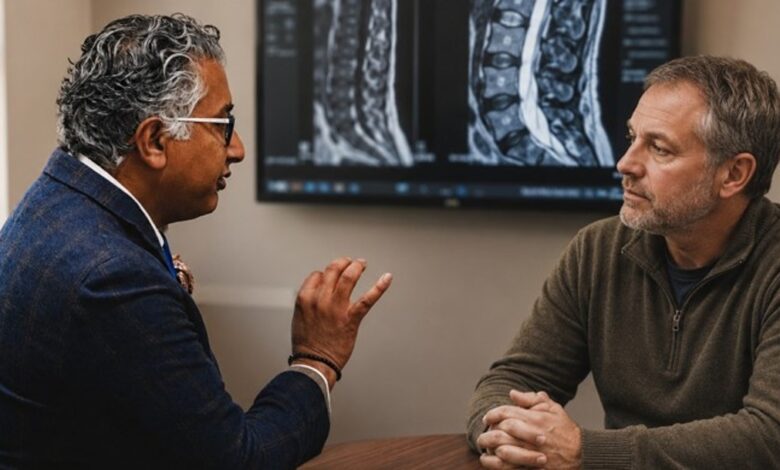
This matters because an abnormal MRI does not automatically identify the best treatment. Similar imaging findings can affect two people very differently. One patient may have mild symptoms that improve with therapy, while another may have progressive weakness or nerve compression that changes the urgency of treatment.
A useful treatment plan connects the diagnosis with the way symptoms affect everyday life. Work demands, mobility, sleep, exercise, previous treatments, and neurological changes can all influence the next step.
4. Technology and Motion Preservation Are Part of His Approach
Dr. Woods’ public profile includes minimally invasive and robotic-assisted spine surgery. Vertrae® also describes a motion-preserving philosophy called MotionFirst™, which emphasizes considering healthy movement when clinically appropriate.
Modern technology can support surgical planning and precision, but it does not replace judgment. Robotic guidance, minimally invasive techniques, disc replacement, decompression, fusion, and other procedures each have specific uses, limitations, and potential risks.
The meaningful question is not whether an advanced tool is available. It is whether that tool fits the diagnosis, anatomy, and goals of the patient.
Motion preservation follows the same principle. Some patients may be candidates for procedures designed to preserve movement, while others need stabilization, a different operation, or no surgery at all. A patient-centered consultation should explain what a recommended treatment is intended to accomplish and why it fits the particular problem.
Technology is most useful when it supports a clear clinical goal rather than becoming the reason for treatment by itself.
5. His Public Philosophy Emphasizes Listening and Patient Partnership
Dr. Woods’ official biography emphasizes listening to patients and treating them as partners in recovery.
That idea can be especially important in spine care because patients often arrive with a long history of symptoms. Some have already tried medication, physical therapy, injections, activity modification, or other treatments. Others may be hearing that surgery is a possibility for the first time.
Clear communication helps make a complicated situation easier to understand. Patients should know what is believed to be causing their symptoms, what reasonable options exist, what each option is intended to accomplish, and what recovery may involve.
Patient goals also matter. One person may want to return to physically demanding work. Another may want to walk farther, sleep better, exercise again, or complete everyday activities with less limitation.
A strong consultation connects medical findings with those goals instead of treating imaging as the entire story. It also gives patients room to ask questions, understand tradeoffs, and participate meaningfully in decisions about their care.
Understanding Dr. Woods’ Background Can Help Patients Ask Better Questions
Dr. Kamal Woods’ professional background combines board-certified neurosurgery, advanced orthopedic and neurosurgical spine fellowship training, healthcare leadership, business education, and experience with minimally invasive and robotic-assisted techniques.
Those credentials provide useful context, but they cannot tell any individual patient which treatment will be appropriate. The most important step remains an accurate evaluation followed by a clear discussion of realistic options.
Patients researching a spine specialist can use a physician’s biography to guide better questions. What is causing the symptoms? Are conservative treatments reasonable? What happens if treatment is delayed? If surgery is recommended, what is the goal? What alternatives are available? How could treatment affect movement, recovery, and everyday life?
The value of a physician’s training is ultimately found in how that knowledge is applied. Specialized education, technology, and leadership matter most when they support thoughtful diagnosis, honest communication, and treatment that is matched to the individual.
For patients considering Vertrae®, learning about Dr. Woods can provide a clearer sense of the experience behind the practice. That context can also make the consultation feel less overwhelming because patients arrive with clearer expectations and priorities. The goal is not to choose a procedure from a menu. It is to understand the problem, weigh the options, and make an informed decision based on medical evidence, personal goals, and a care plan designed around the patient.