Over the past decade, the automotive industry has undergone significant changes, with numerous new and improved vehicles entering the market. However, with these technologies come many different life-threatening risks. Every car manufacturer is competing to produce the best car, one that is faster, smarter, and safer.
The best part is that many of them have succeeded in making cars safer than others. Many new technologies, such as automatic braking and blind-spot alerts, have evolved from a reactive to a preventive approach.
However, the most important question remains: which of these new safety technologies are truly effective? Which of them has truly made a difference? So, let’s learn about 7 car safety technologies that actually save drivers’ lives.
Automatic Emergency Braking (AEB)
You are driving home from the office, feeling tired and just wanting to get home and relax. You see, the road is clear, so you think I can go a bit faster on this road, which will cut down on the time it usually takes me to get home.
So you do just that, you speed up!
You don’t notice a stopped car in the road because you expected it to be clear.
You don’t have time to react; you suddenly panic. However, you are too close for your car to stop completely. This is where AEB acts as your security guard. It uses forward-facing sensors, radar, or cameras to detect an impending collision. This means even if you don’t have a reaction in time, your car will. Its system will apply automatic breaks, saving you and reducing the impact of the accident.
For the automotive industry, expertise in servicing, repairing, and reinstalling AEB sensors is now crucial. As most modern vehicles include AEB, mechanics and repair shops must be proficient in these systems to remain competitive and current in the industry.
Lane Departure Warning and Lane Keeping Assist
Lane Departure Warning (LDW) and Lane Keeping Assist (LKA) are easily among the most helpful and impressive safety features.
Imagine you’re driving home late, feeling exhausted, and struggling to stay focused and keep your car in its lane. In an older vehicle without features like Lane Departure Warning (LDW) or Lane Keeping Assist (LKA), this situation would be incredibly difficult. However, modern cars equipped with these technologies offer a much easier and safer experience.
Modern mechanics are increasingly encountering vehicles with steering wheel sensor or alignment problems. These issues can often be rectified through wheel balancing and suspension repairs. The use of auto repair shop software is essential as it helps mechanics identify calibration errors and other issues with newer vehicles. Even minor calibration inaccuracies can compromise the system’s ability to detect road conditions and other hazards, potentially leading to serious accidents.
Blind Spot Detection (BSD)
Blind spot detection (BSD) is a highly dependable and beneficial car safety feature that has significantly enhanced driving safety. It makes maneuvering in and out of tight spaces much easier and quicker. Instead of having to fully turn to assess the distance of surrounding vehicles, drivers can rely on a 360-degree camera view, which provides constant awareness of the vehicle’s surroundings.
It also makes parking easier for new drivers. Not only that, but it also makes driving easier for them because most sensors alert drivers about vehicles approaching from adjacent lanes and flash lights or make sounds to alert the driver about unsafe lane changes.
Blind-spot accidents are a major problem. According to a report from the National Highway Traffic Safety Administration (NHTSA), over 800,000 collisions each year in the U.S. are due to blind spots in cars.
Blind Spot Detection (BSD) technology helps prevent these dangerous side-impact crashes, which often happen on highways.
Advanced Driver Assistance Systems (ADAS) Integration
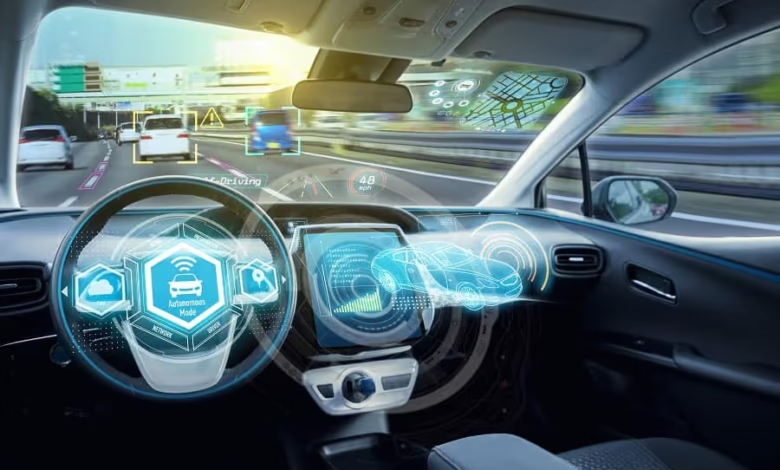
Advanced Driver Assistance Systems (ADAS) Integration offers a comprehensive safety solution by combining various systems such as Automatic Emergency Braking (AEB), Lane Keeping Assist (LKA), and Blind Spot Detection (BSD) into a unified ‘network.’ This leverages sensors and onboard computers to communicate effectively throughout the vehicle’s entire system, which allows the computers to perform life-saving actions in a fraction of a second.
Today’s vehicles are becoming increasingly intelligent, offering drivers enhanced protection and control, particularly in emergency situations. As the automotive industry advances, it’s crucial for auto shop owners to keep pace with these innovations. This includes not only diagnosing new issues but also resolving them effectively.
Conclusion
Nowadays, driving has become a lot easier. With co-pilot features in vehicles, different sensors enable smarter and faster parking, lane changes, and braking. Every new system that gets introduced leads to more lives saved. Most technicians don’t like cars that are packed with tech because that just means more things might break. However, the modern safety features in newer cars definitely save a lot of lives every year – and this is a tradeoff that we mechanics are more than happy to make.